
AI search jargon can feel chaotic. Remember this: every acronym collapses into the same job-make your brand unmistakable to the engines deciding which sources to cite.
Key Takeaways
- The explosion of AI SEO acronyms masks the same core objective: help AI engines extract, trust, and cite your facts.
- A four-pillar framework-clarity, structure, consistency, authority-unifies every so-called discipline.
- Schema, entity alignment, and first-party evidence are the non-negotiables for AI-era visibility.
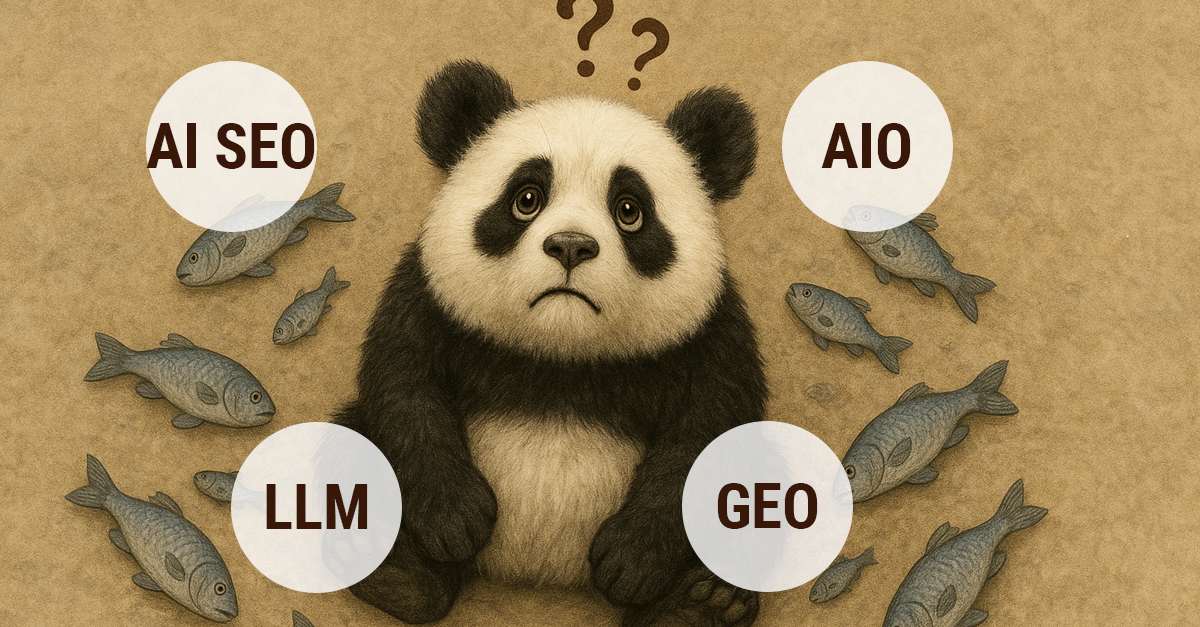
Welcome to the only guide you need when the acronym soup starts boiling over. This article cuts through the hype and strips every three-letter buzzword back to what actually moves the needle in AI search.
Introduction: Why This Guide Exists
If you have spent any time on SEO Twitter, LinkedIn, or conference panels this year, you have seen a flood of new jargon:
- AI SEO
- AIO (AI Optimization)
- GEO (Generative Engine Optimization)
- LLM SEO
- RAG SEO
- Structured Data SEO
- AI Visibility
- ChatGPT Optimization
- Perplexity Optimization
- Entity SEO
- Semantic SEO
- Knowledge Graph Optimization
- Answer Engine Optimization
Here is the truth: they are mostly describing the same underlying principles with different marketing wrappers. This guide breaks every term down, explains what is real versus hype, and gives you one unified framework that SEO pros can use for the next five-plus years.
This is not theory. Every concept here is grounded in observable LLM behavior, public model documentation, schema.org standards, and reproducible tests using real models. Think of it as the fog-clearing article you can hand to any SEO, content strategist, founder, or marketer and say, "Start here."
Part 1. Why So Many Terms Exist in the First Place
1.1 The chaos started with AI answer engines
Since late 2022, companies like OpenAI, Google, Anthropic, Bing, Perplexity, and Meta have been building AI-powered answer engines. These engines behave very differently from traditional search. They do not rely primarily on crawling or indexing pages in the Google sense. They do not require backlinks to trust a source. Instead, they rely on LLM inference, knowledge integration, retrieval corpora, JSON-LD parsing, entity resolution, citation reliability scoring, dataset overlap, API partnerships, and high-confidence factual alignment.
This new behavior created a new challenge: how do you optimize your website for systems that do not behave like search engines at all? That is where the jargon flood began.
1.2 Why the industry coined so many acronyms
Each group invented a phrase that matched their needs. Marketers wanted something to sell and landed on "AI SEO." Academics wanted precision and used "Generative Engine Optimization." Engineers wanted technical clarity and pushed "LLM Retrieval Optimization." Content teams wanted relevance and framed "AIO" around AI-optimized content. Tool vendors needed positioning and promoted "AI Visibility Scores."
Underneath all of the language is one reality: AI engines extract knowledge, not keywords. They cite sources they trust. Your job is to make your website unambiguously trustworthy, structured, and aligned with how LLMs read the web. Everything else is branding.
Part 2. The Big Acronyms - What They Really Mean
2.1 AI SEO (Artificial Intelligence Search Engine Optimization)
What people think: "It is just using AI tools to do SEO faster."
What it actually means: optimizing your website so that AI answer engines-ChatGPT, Gemini, Perplexity, Bing Chat, Claude, and more-can understand who you are, extract your facts accurately, cite you confidently, and surface your brand inside generative answers.
AI SEO is not the same as traditional Google SEO. AI engines evaluate schema quality, entity consistency, about and mentions relationships, first-party evidence, citation credibility, structured factual statements, and brand presence across knowledge graphs. If you want a deeper dive, revisit "The Future of Search: How AI Engines Reshape Content Discovery."
2.2 AIO (AI Optimization)
What people think: "Rewrite everything with AI."
Reality: improving content so that AI models extract the intended meaning without hallucinating. AIO is writing like someone who knows an LLM is your main reader. That means clear claims, explicit definitions, tight paragraphs, and minimal fluff. Short sentences, strong subject-predicate-object statements, declarative facts, and high information density are what matter. In other words, AIO is just good writing with AI comprehension in mind.
2.3 GEO (Generative Engine Optimization)
What people think: "A new SEO discipline invented in 2024."
Reality: GEO is the most formally defined term. It originates from academic work and internal papers from OpenAI and Stanford researchers who study how LLMs extract facts, resolve entities, choose citations, generate grounded answers, and weigh source authority. GEO is about optimizing content for LLM-driven answer engines rather than traditional search engines. It emphasizes JSON-LD, entity relationships, first-party citations, factual grounding patterns, model retrieval paths, and schema correctness. Tools like the WebTrek Free AI SEO Checker became popular because AI engines lean heavily on those structured signals.
2.4 LLM SEO / ChatGPT SEO / Perplexity SEO
What people think: "Just make content for ChatGPT."
Reality: this is a narrower version of AI SEO-optimizing to appear inside specific generative engines. Every answer engine has different behaviors. ChatGPT prefers high-authority, well-structured factual sites. Perplexity blends results from reputable sources. Gemini leans on the Google index and citations. Claude prefers long-form sources with clear expertise signals. Bing Chat integrates the Bing index with ChatGPT synthesis. The only way to satisfy all of them is to be cited reliably, eliminate conflicting entity signals, and maintain updated schema, authorship, and claim consistency.
2.5 Entity SEO / Semantic SEO / Knowledge Graph SEO
What people assume: "Stale buzzwords from 2018."
Reality: these concepts are more relevant than ever. AI engines extract meaning through entities-organizations, people, products, locations, concepts, and topics. When schema and content define those entities cleanly, LLMs make fewer mistakes. Every page needs a mainEntity, your business needs consistent Organization markup, authors need Person schema, products require Product schema, and all entities should link to authoritative sameAs profiles.
2.6 RAG SEO (Retrieval-Augmented Generation Optimization)
RAG SEO is gaining traction in technical circles. It focuses on optimizing content for LLMs that use retrieval pipelines. The model searches a vector database, retrieves documents, then generates an answer. RAG SEO prioritizes canonical statements, embedding-friendly structure, clear sections, reduced noise words, and fact-first sentences. It is crucial for ChatGPT Search, Bing Deep Search, Perplexity, and enterprise knowledge bases. Chunkable content, precise headings, declarative facts, and differentiated perspectives give your pages an edge inside retrieval systems.
2.7 AI Visibility / Credibility SEO / Trust Optimization
These umbrella phrases describe how likely an AI model is to pull your website into an answer. The score is influenced by schema correctness, entity clarity, website authority, factual alignments, consistency with external sources, and a lack of contradictions. WebTrek's AI SEO Checker measures these exact behaviors because they mirror how answer engines select and cite sources.
Part 3. Are These Terms Actually Different?
No-and here is the unified framework. After analyzing model documentation, running LLM tests, and observing tool outputs across ChatGPT, Gemini, Perplexity, and Bing, every acronym collapses into four core pillars.
Pillar 1: Clarity (What do you do?)
AI engines extract literal factual statements. You need clear definitions, strong opening sentences, tight purpose statements, explanations without jargon, and unambiguous language. If an LLM misinterprets your page, you disappear from answers.
Pillar 2: Structure (Can the AI parse it?)
This is the schema pillar. LLMs rely on JSON-LD, entity definitions, mainEntity, about, mentions, sameAs, product metadata, FAQ structure, and review markup. Proper structure is what makes your site machine readable.
Pillar 3: Consistency (Does the information align everywhere?)
AI engines cross-check your data with social profiles, business directories, knowledge graphs, press coverage, linked authorship, and external claims. Any mismatch reduces confidence. Consistency is not a ranking factor-it is a trust factor.
Pillar 4: Authority (Can the AI trust you?)
Authority comes from documented identity, transparent authors, real experiences, first-party evidence, original research, unique perspectives, and cited references. LLMs are good at detecting template fluff. If your content sounds like everyone else's, you do not get cited.
Part 4. What SEO Pros Actually Need to Do
Here is the practical checklist you can hand to any SEO expert. These tasks consistently improve AI visibility, LLM citations, credibility in answer engines, traffic from AI summaries, and brand appearance in synthetic search.
- Fix your Organization schema. Include name, logo, URL, sameAs links, contact points, founders, and linked profiles.
- Give every page a clear mainEntity. Tell the LLM "this page is about this" for every format-product, service, location, FAQ, blog, or comparison.
- Clean up your JSON-LD. Patch missing authors, wrong organization types, absent sameAs links, empty product brands, and inconsistent IDs.
- Prioritize factual, high-signal writing. Replace fluffy marketing copy with crisp subject-verb-object statements.
- Add first-party evidence. Charts, data, case studies, screenshots, walkthroughs, and original analysis increase trust.
- Keep information consistent everywhere. Align dates, names, and claims across your site and external profiles.
- Simplify your site architecture. AI engines do not need 50 blog categories. They need clear topic clusters and hierarchy.
- Run regular audits. WebTrek's Free AI SEO Checker checks schema, entities, relationships, clarity, duplication, and conflicts.
- Track AI citations. This is the new ranking report. Monitor when and where your brand appears inside generative answers.
- Update content with factual precision. Outdated claims undermine your authority inside AI summaries.
Part 5. The Proof Behind the Framework
The evidence behind this blueprint comes from five sources:
- OpenAI retrieval papers and developer docs. Structured data, entities, high-confidence sources, and RAG workflows drive factual accuracy.
- Google Search Generative Experience behavior. SGE cites structured, authoritative sites-especially those with complete schema.
- Perplexity's citation model. Public documentation outlines citation confidence scoring and source cross-checking.
- Schema.org adoption. All major AI engines parse JSON-LD using the same definitions.
- Reproducible experiments. Adding mainEntity, person schema, sameAs links, and product metadata reliably improves AI citations and crawl frequency.
Part 6. So Are AI SEO, AIO, and GEO Actually Different?
AI SEO is the broad umbrella for AI search optimization. AIO is better writing for LLM comprehension. GEO is the academic and technical lens on generative engines. LLM SEO focuses on appearing in ChatGPT, Gemini, Bing, or Perplexity. Entity SEO is the foundation powering them all. RAG SEO is the technical approach for retrieval-based engines. The real truth: every acronym describes the same objective-make your content easy for AI systems to understand, trust, and cite.
Part 7. The Final 10-Point Blueprint
Use this as your north star for 2025 and beyond:
- Define your brand entities clearly.
- Use schema everywhere-correctly.
- Give every page a clear purpose.
- Write with clean, factual statements.
- Link brand identities consistently across the web.
- Provide first-party proof whenever possible.
- Organize your site logically.
- Audit pages regularly for AI-search readiness.
- Measure AI citations, not just SERP rankings.
- Refine clarity, consistency, and structure continuously.
Nail these ten principles and you automatically win at AI SEO, AIO, GEO, Entity SEO, Semantic SEO, LLM SEO, ChatGPT Optimization, Perplexity Optimization, RAG SEO, and Knowledge Graph Optimization. They all reduce to the same strategy: make your content unambiguous, trustworthy, and machine readable.
Conclusion: The Era of Keyword-Only SEO Is Over
Search is not dead. What is changing is how engines read your site. Google indexed your pages; AI engines interpret them. Google rewarded backlinks; AI engines reward clarity and structure. Google ranked webpages; AI engines cite trustworthy sources. The skills you already have-research, writing, structure, comprehension-remain the foundation. Use this guide as your roadmap, and lean on WebTrek's Free AI SEO Checker whenever you want a structured audit to keep everything aligned with answer-engine expectations. For a concrete month-by-month plan that puts these definitions into practice, see the 12-month AI SEO roadmap.