
Before testing emojis as a CTR lever, understand what search engines actually do with them. Google frequently rewrites titles and may strip emojis entirely. AI systems ignore emoji semantics. If your title has a clarity problem, an emoji will not fix it.
Key Takeaways
- Google can render emojis in SERP titles but also strips them, especially when its quality filters flag the result as spammy or low-confidence.
- Emojis may create visual contrast in a busy search results page, but contrast alone does not drive the click. Searchers evaluate trust, relevance, and decision fit before clicking.
- AI search engines treat emojis as semantically empty. They add no clarity, no citation signal, and no interpretive value in AI-driven results.
- The cases where emojis are worth testing are narrow: casual consumer intent, strong brand familiarity, and queries where attention capture genuinely precedes the trust decision.
- If a title needs emojis to stand out, the title itself probably needs to be rewritten first.
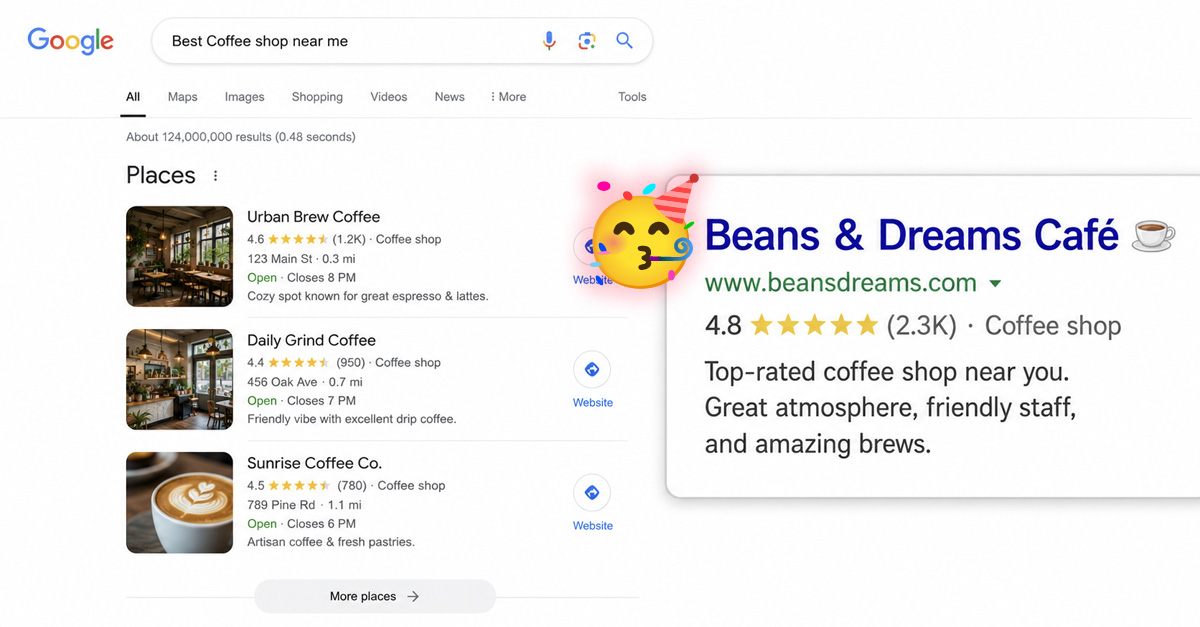
Introduction: The Emoji CTR Question Is Actually Two Different Questions
When someone asks whether emojis in title tags improve CTR, they are usually bundling two separate problems. The first is a rendering question: does the emoji appear in the search result at all? The second is a click behavior question: if it appears, does it make searchers more likely to click?
Both matter, but they fail in different ways. If Google strips the emoji from your title before the result renders, the whole conversation is moot. If the emoji renders but the query context makes it look out of place, it can actively work against the result.
There is a third question that most emoji discussions miss entirely: what happens when that same page appears in an AI-generated answer? That surface does not process visual symbols the same way a standard SERP does, and the distinction changes how you should weigh emoji use as a signal worth testing. This post addresses all three questions in sequence.
How Google Actually Handles Emojis in Title Tags
Google does not have a blanket rule that strips all emojis from titles. It can and does display them in search results in certain contexts. But Google also rewrites a large portion of title tags based on its own judgment about quality, relevance, and user experience. That rewriting process may or may not preserve whatever emoji you placed in the source code.
The factors that appear to influence emoji rendering include the device and operating system used to view the result, whether Google's quality systems classify the emoji as decorative or spammy, the search intent behind the query, and whether the emoji appears at the start, middle, or end of the title. Emojis placed at the very beginning of a title are more likely to be treated differently than those embedded naturally within the text.
The practical implication is that even if you optimize for emoji visibility, you are optimizing for a signal you do not fully control. Google may render your emoji on a desktop result and omit it from a mobile result, or display it for one query cluster and suppress it for another. Testing emoji rendering requires real SERP sampling across devices and queries, not just a single screenshot that happened to show the emoji appearing.
The Visual Attention Argument: When Emojis Might Help
The case for emojis rests on a real principle: results that look visually distinct from surrounding results attract more initial attention. In a SERP where most titles are text-only, a single emoji can function as a pattern break. That pattern break gets eyeball time before the searcher reads a single word.
This attention effect is real, but it is also easily overstated. Attention capture is not the same as click selection. Searchers look at a result and then decide whether it matches what they want. If the decision stage is evaluative or trust-sensitive, an emoji can make the result look less authoritative before the text even registers.
Consider a situation where two results appear at the same rank for a question like "what is the best CRM for small teams." One title reads "Best CRM for Small Teams: A Practical Comparison." Another includes an emoji before those same words. The emoji version may attract a first glance, but whether that glance converts to a click depends on how the searcher interprets the symbol in relation to the decision they are trying to make. For a casual consumer query, an emoji might feel friendly. For a business tool comparison, it can feel imprecise.
The attention argument for emojis works best when: the query suggests casual browsing rather than a committed evaluation, the emoji is directly relevant to the topic rather than generic, competing results on the same SERP are heavily text-dense, and the brand already has some recognition so the result is not relying on trust signals from scratch.
The Trust and Quality Signal Problem: When Emojis Hurt
Most CTR discussions treat emojis as a neutral novelty, as if the only variable is whether they attract attention. That framing misses how searchers use SERP signals to pre-qualify pages before clicking. Title construction is part of that pre-qualification process.
When a result title contains an emoji in a context where the query suggests a high-stakes or professional decision, the emoji can read as a credibility gap. This is especially common in finance, health, legal, B2B software, and technical documentation queries. Searchers in those contexts are scanning for authority markers: specificity, recognized terminology, format signals, and brand familiarity. An emoji does not contribute to any of those signals and can subtract from them by making the result look like content designed to attract clicks rather than answer the question.
The same problem appears in query contexts where multiple competitors use emojis aggressively. Once enough results on a SERP use them, the pattern-break effect disappears and each emoji-heavy result starts to look like a promotional listing rather than a useful resource. Searchers adapt by gravitating toward whichever result looks most plainly authoritative, which often means the one with the cleanest, most specific title language.
For a detailed look at how title-level trust signals connect to broader CTR mechanics, see How to Improve Organic CTR Without Ranking Higher. The emoji question is one piece of a larger title optimization decision that starts well before any symbol is added.
How AI Search Engines Interpret Emojis Differently
The rise of AI-generated search results adds a layer to the emoji decision that traditional CTR discussions do not account for. Classic SERP optimization focuses on click behavior in a ranked list. AI search presents a different surface: synthesized answers that pull from pages, often without linking to them directly. In that environment, what matters is whether a page is cited, excerpted, or represented in the response, not whether it looks visually distinct in a list.
AI search systems process language semantically. They extract meaning from word relationships, sentence structure, named entities, and contextual framing. Emojis are not part of that semantic fabric. A currency symbol emoji does not signal financial concepts to a language model the way the words "revenue" or "profit" do. It is read as a Unicode character that belongs to a symbol class the model does not assign linguistic weight to. At best, the emoji is ignored. At worst, it adds minor parsing noise that briefly disrupts the model's reading of the surrounding text.
This does not mean emojis catastrophically damage AI search visibility. A single emoji in a well-structured title is unlikely to suppress a citation on its own. But it also provides no benefit in that environment, which changes the calculation. If your goal is to optimize for both traditional CTR and AI search presence simultaneously, emojis offer an asymmetric tradeoff: uncertain upside in traditional SERPs and zero upside in AI surfaces.
The Free AI SEO Checker evaluates how AI systems read your page, including title tag clarity, entity recognition, and heading structure. If your title contains emojis and the tool flags a clarity or interpretation issue, that is a signal worth addressing before testing emoji-based changes.
When Emojis Might Be Worth Testing
Given those constraints, there is still a narrow set of conditions where an emoji in a title tag is worth a structured test. The conditions are not about the emoji itself. They are about the search context and the title's existing performance.
The first condition is query intent. Consumer-facing informational queries in lifestyle, food, travel, entertainment, or community-oriented topics are better candidates than professional, financial, or technical queries. The emotional register of the query has to match the register of a symbol before the symbol does useful work.
The second condition is baseline title strength. An emoji cannot compensate for a weak title. If the title is already vague, uses filler phrases, or buries the differentiator, a test that adds an emoji before fixing the copy will produce noise rather than a clean signal. Fix the title's clarity first, then test whether the emoji provides additional lift in the cases where both conditions are met.
The third condition is render rate. Before measuring CTR impact, verify that Google is actually rendering the emoji across the primary devices and query variants for that page. Sampling SERP results across mobile and desktop for your target queries gives you a rough sense of whether the treatment is live. If render rate is inconsistent, your CTR test is measuring a mixed treatment, which makes interpretation unreliable.
The fourth condition is competitive density. If several strong competitors in your SERP cluster are already using emojis, the visual novelty effect is already diminished for that result set. Adding an emoji in that environment is more likely to make you look similar than distinct.
The Practical Verdict: Clarity Comes Before Novelty
The most common mistake with emoji testing is treating it as a free or low-risk CTR lift. The emoji question sits inside a larger title optimization decision that starts with: does this title clearly match the searcher's decision stage, front-load the most relevant signal, and set an accurate expectation about the page? If the answer to any of those is no, that is the problem to fix first.
A well-constructed title with no emoji will almost always outperform a weak title with one. The emoji is a decoration. The title is a promise. Searchers evaluate the promise, not the decoration, and search engines often decide whether the decoration survives into the final result anyway.
For pages that already have strong, specific, stage-matched titles and are competing in casual consumer query spaces, a structured emoji test in a low-trust-sensitivity context is reasonable. Run it by query class rather than sitewide, verify render consistency before drawing conclusions, and set a measurement window that accounts for natural SERP volatility. For everything else, the time is better spent on title clarity, meta description relevance, and snippet-to-page alignment. Those changes are under your control and affect every surface where your content appears, including the AI search results that emojis have no influence over at all.
For the full framework on diagnosing and improving low-CTR pages before making any snippet changes, see How to Improve Organic CTR Without Ranking Higher. Emoji testing belongs near the end of that checklist, not the beginning.
FAQs
Do emojis in title tags show up in Google search results?
Sometimes. Google can render emojis in SERP titles, but it also rewrites and strips them based on its quality signals and the search context. There is no guarantee that emojis placed in your HTML title tag will appear in the final rendered result.
Do emojis help click-through rate in SEO?
The outcome depends on the query context. Emojis can create visual contrast in a text-heavy SERP, which may attract initial attention. But if the query calls for trust signals or professional decision support, an emoji can reduce perceived credibility and suppress clicks rather than lift them.
How do AI search engines handle emojis in titles?
AI search systems process language semantically and treat emojis as Unicode symbols without linguistic weight. They do not improve clarity, citation likelihood, or entity recognition in AI-generated answers. For AI search visibility, clear language structure matters more than visual symbols.
When should you avoid emojis in title tags?
Avoid them when the query suggests a high-trust, professional, or technical decision. Also avoid them when the title itself needs clarity improvements first, when competitors on the same SERP are already using emojis heavily, or when you cannot verify consistent rendering across devices and queries.
Final Takeaway
Emojis in title tags are a narrow, context-dependent tactic, not a reliable CTR lever. Google controls whether they render. The query context determines whether they help or hurt. AI search surfaces ignore them entirely. Before testing an emoji, make sure the title is already specific, the meta description is earning the click, and the result matches the decision stage of the query.
If those conditions are met and the query space is casual and consumer-facing, a structured test with clear render verification and a focused measurement cohort is a reasonable next step. If those conditions are not met, fixing the fundamentals will produce more reliable gains than any symbol added to the title.