
This was a small business experiment, not a promise of universal results. We were trying to understand what became easier to find, easier to describe, and easier to trust after a focused set of website improvements.
Key Takeaways
- Bubble Nation treated this as a practical case study, not a generic SEO playbook, focusing on a few site changes that could realistically be maintained by a local shop.
- The biggest updates were structural and editorial: clearer page roles, stronger local context, cleaner internal connections, and more explicit language about what the shop offers.
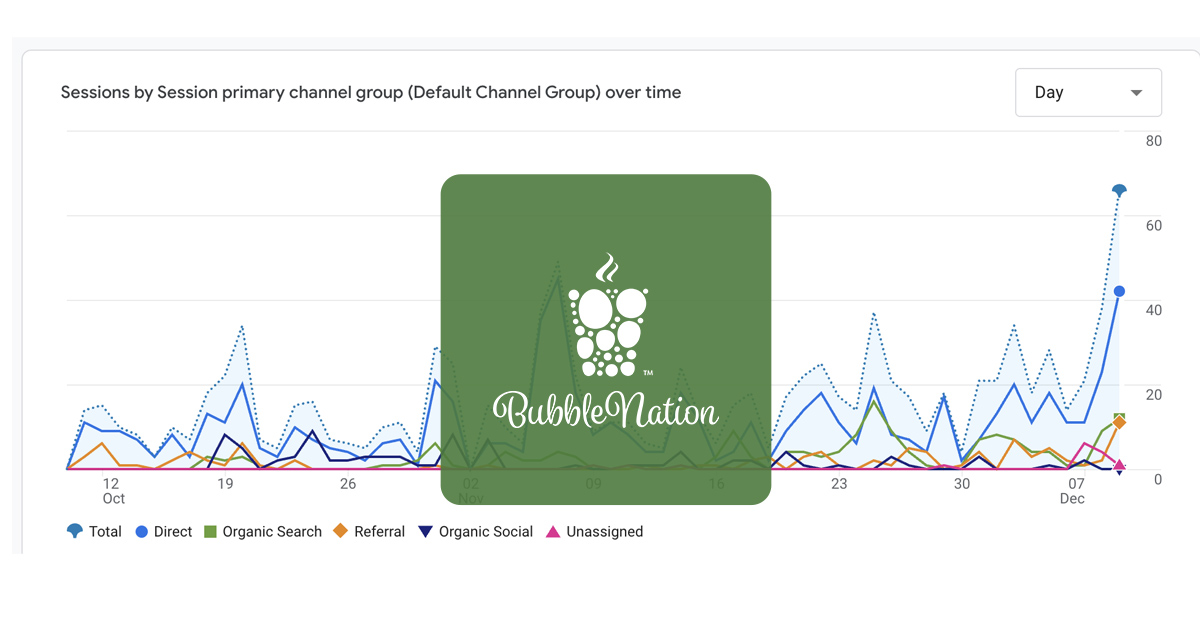
- After the updates, we observed healthier search patterns, including sharper traffic spikes around relevant pages, a steadier baseline over time, and more consistent descriptions in AI search checks.
- Some prompts still produced mixed results, which is exactly why ongoing review mattered more than treating one round of changes as finished.
Business Context
Bubble Nation is a local bubble tea shop, not an SEO publisher. The goal of this project was not to turn the website into a marketing content machine. It was to make the site easier for real customers to find and easier for search systems to understand.
That distinction mattered from the start. A local shop has different constraints than a software company or agency site. We needed pages that reflected the business clearly, supported local discovery, and stayed practical to maintain. We were not trying to publish dozens of articles or chase abstract visibility metrics for their own sake.
The working question was simple: if we made Bubble Nation's site structure, business details, and page purpose clearer, would that make the shop easier to discover through both traditional search and AI-generated search experiences such as ChatGPT and Google AI Overviews?
That also meant looking more directly at AI search, including how the business appeared in AI search results such as ChatGPT responses or Google AI Overviews when people searched for relevant local options.
This case study documents what we tested, what we observed, and what we think other local businesses can reasonably learn from it.
Initial Problem
Before making changes, the website had the kind of issues many local business sites accumulate over time. The basic information existed, but it was not always presented in the clearest possible way. Important details about the shop, the product category, and the role of specific pages were present, but spread across the site unevenly.
We noticed a few early signs of friction. Some pages felt broad when they should have been specific. Some internal paths made sense to returning customers but were less helpful for someone discovering the business for the first time. Manual checks in AI search tools sometimes described Bubble Nation accurately and sometimes stayed vague or surfaced a less useful page.
None of that meant the site was broken. It meant the site was harder to interpret than it needed to be. For a local business, that can quietly limit discoverability even when the brand already has a real customer base and real demand.
Instead of treating this as a pure traffic problem, we treated it as a clarity problem. We wanted to see whether stronger structure and cleaner language would make Bubble Nation easier to classify, summarize, and connect to the right local intent.
Actions Taken
We kept the scope intentionally small. The point was to test realistic improvements a local business could actually ship, review, and maintain.
1. We tightened page purpose
We reviewed the homepage and other key pages to make sure each one had a clear job. The homepage needed to explain what Bubble Nation is, where it operates, and what kind of customer it serves. Supporting pages needed to reinforce that instead of competing with it. This was less about adding more text and more about removing ambiguity.
2. We made local context more explicit
Rather than assuming search systems would infer everything from scattered mentions, we made business details easier to read directly. That included clearer references to the shop category, what customers can expect, and the kind of local search intent the site should match. For a neighborhood business, explicit context often helps more than clever wording.
3. We cleaned up internal connections
We reviewed how important pages supported one another. The goal was to make the site easier to navigate for users and easier to interpret as a coherent set of signals. Stronger internal linking also helped clarify which pages were foundational and which pages were supporting context.
4. We checked how the site appeared in AI search
To avoid guessing, we used a lightweight review process that included manual prompt checks and a soft use of WebTrek's AI visibility checker. That helped us compare whether Bubble Nation appeared consistently, which pages surfaced, and how the business was described across different prompt types.
5. We used a page level review for unclear URLs
When a page looked weak or hard to interpret, we used WebTrek's AI SEO tool as a secondary diagnostic layer. We were not using it as a magic answer. We used it to pressure test whether page wording, structure, or missing context might be limiting how clearly the page could be understood.
Observed Results
We did not see a perfectly linear result, and we would not expect one. Some days were quiet. Some prompt checks were inconsistent. Some pages responded more quickly than others. That is normal.
What we did observe was directional improvement. Search patterns suggested that the updated site was doing a better job matching the right kind of discovery intent. Traffic showed more noticeable spikes around relevant updates, and over time the baseline looked healthier than it did before the cleanup. That does not prove a single cause, but it was a useful signal.
We also observed that Bubble Nation became easier to describe consistently in manual AI checks. When we tested how sites appear in AI search, the business framing was more stable and the surfaced pages made more sense. The results were not perfect across every prompt, but the overall pattern felt less noisy.
In practical terms, that gave us more confidence that Bubble Nation was becoming easier to interpret in AI search results, not just easier to measure through internal site reviews.
Another useful change was internal to our own review process. After the updates, it became easier to tell which page should own which intent. That made future edits less random. Instead of continuously adding new copy, we could focus on strengthening the specific pages that mattered most.
Just as important, we saw what did not change overnight. Visibility in AI systems still varied by prompt wording and by platform. That reinforced the idea that one round of fixes can improve clarity without creating guaranteed inclusion everywhere.
Interpretation
Our interpretation is not that Bubble Nation found a secret formula. It is that local business websites often benefit from being easier to classify, easier to summarize, and easier to connect to real local intent.
The changes that seemed most helpful were not flashy. We did not publish a large content campaign. We did not chase precise scoring targets. We focused on cleaner business context, clearer page roles, and better support between important pages. That appears to have reduced ambiguity for both search engines and AI systems.
This also changed how we think about visibility. A local business does not need every page to behave like a high volume SEO asset. It needs the right pages to communicate the business clearly enough that customers and search systems can both get oriented quickly. In that sense, discoverability starts with comprehension.
There is also a practical lesson here about measurement. Looking only at raw traffic would have missed part of the story. Looking only at AI prompts would have missed another part. The more useful view came from combining local SEO observations, page structure review, and a repeatable check of how Bubble Nation showed up in AI search.
Takeaways
For Bubble Nation, this project worked best as an experiment in clarity, not an exercise in chasing generic SEO advice. We tested a manageable set of improvements, watched how the site behaved, and used those observations to make the next round of decisions more grounded.
If there is one practical takeaway for other local businesses, it is this: start by making your site easier to understand before you try to make it bigger. Clear business context, cleaner page roles, and stronger internal support can do more for discoverability than a rushed pile of content.
The second takeaway is to treat results directionally. We observed stronger patterns, a better baseline, and more consistent AI visibility checks after the updates, but we are not treating those observations as guarantees. Local search and AI search both move in ways that are sometimes uneven.
The final takeaway is that small businesses can learn a lot from running their own case studies. You do not need to behave like an SEO authority site to improve discoverability. You just need to document what you changed, what the site did afterward, and what seems worth repeating.