
Global quick win: Inventory every locale’s schema and lock shared IDs, sameAs references, and core descriptions before translating the next page. Consistent identifiers boost cross-language entity confidence immediately.
Key Takeaways
- AI search evaluates your brand as a single entity, so multilingual visibility depends on alignment across every localized asset.
- Define entity architecture and schema governance centrally, then let local teams adapt within clear semantic guardrails.
- Voice, depth, FAQs, and internal linking must preserve meaning-not just translation quality-to keep AI answers consistent.
- Measure how AI systems describe you in each language and fix gaps before uncertainty fragments your brand narrative.
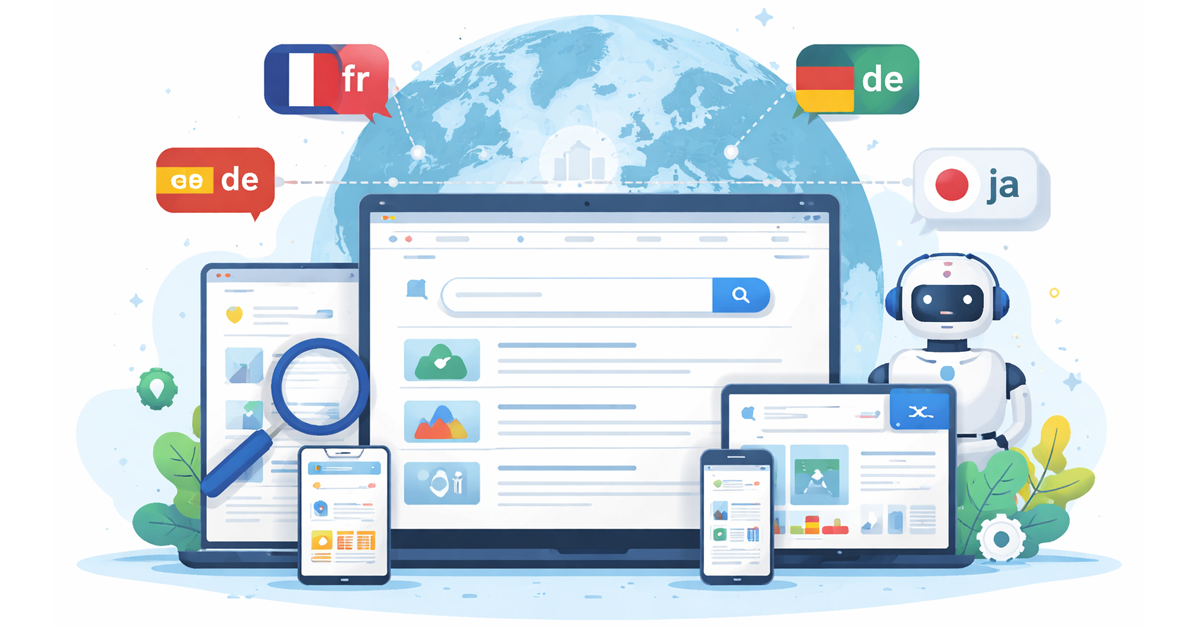
Why AI Search Changes Multilingual Visibility
AI-driven search has changed what it means for a brand to be “visible” internationally. In traditional multilingual SEO, success was measured by whether each localized page ranked well in its own market. As long as hreflang was correct, translations were accurate, and local keywords were targeted, most teams considered the job done.
AI search systems do not evaluate websites that way. Large language models synthesize information across languages, sources, and formats to form a single understanding of what a brand is, what it does, and whether it is trustworthy. Your English, German, Japanese, and French pages are not treated as separate properties. They are treated as evidence describing the same underlying entity.
This creates a new challenge for global sites: keeping that entity consistent across languages, even when content is localized, maintained by different teams, and optimized for different markets.
Multi-language AI SEO is not primarily a translation problem. It is an entity consistency problem.
From Multilingual SEO to Multilingual AI Visibility
The core shift is subtle but profound. Traditional international SEO optimized pages per locale. AI search evaluates brands as unified entities.
AI systems are constantly trying to answer a small set of foundational questions:
- What is this organization?
- What problem does it primarily solve?
- Who is it for?
- What category does it belong to?
- Why should it be trusted?
These questions are answered probabilistically, based on everything the model has seen about your brand. When those answers resolve consistently across languages, AI systems gain confidence. When they conflict, confidence drops. This is why some global brands appear consistently in AI answers worldwide, while others appear inconsistently or not at all-even when their localized SEO performance looks strong.
Why Multilingual Sites Quietly Lose AI Visibility
Most multilingual sites do not fail because of obvious errors. They fail because of accumulated inconsistency.
Common patterns include:
- Each locale describes the brand slightly differently
- Product definitions shift by market
- One language emphasizes software, another emphasizes services
- Structured data is implemented independently per region
- Localized pages are much thinner than the global version
None of these issues look catastrophic in isolation. Together, they fragment the brand’s entity. To humans, these differences feel like reasonable localization. To AI systems, they look like uncertainty about what the brand actually is. When AI systems encounter uncertainty, they respond conservatively. They generalize, hedge, or select alternative sources with clearer signals.
Entity Consistency Matters More Than Translation Quality
High-quality translation does not guarantee semantic consistency. Small linguistic differences can materially change how AI systems interpret meaning. Changes in certainty, scope, or emphasis are especially impactful. A definitive statement in English can become a tentative suggestion in another language simply through cautious translation choices.
Over time, these shifts compound. The brand’s entity becomes fuzzy, not because the information is wrong, but because it is not aligned. This is why multilingual AI SEO starts with defining entities, not with translating pages.
Define Your Entity Architecture Before You Localize
Before content is written or translated, global teams should define an explicit entity architecture.
At a minimum, this includes:
- The organization entity
- Primary products or services
- Key sub-products or modules
- Core problem domains the brand owns
For each entity, teams should document what is invariant across languages and what may vary locally. Invariant attributes are not marketing copy. They are factual claims AI systems rely on to classify and trust the entity. Once this architecture exists, localization becomes controlled variation rather than improvisation. Local teams still adapt messaging, but they do so within semantic guardrails.
Structured Data Is the Normalization Layer
Schema plays a central role in enforcing entity consistency across languages. While AI systems ingest unstructured text, structured data anchors interpretation. For multilingual sites, schema should communicate one clear message: this is the same organization, the same product, the same service-expressed in different languages.
Best practices include:
- A single global Organization entity referenced across all locales
- Consistent identifiers, names, and core descriptions
- Locked invariant properties that cannot drift
- Clearly scoped localized fields
Schema should not be where entity strategy is invented. It should be where it is enforced. Using a schema generator with centralized templates helps prevent accidental divergence when multiple teams and markets are involved.
Common Multilingual Schema Mistakes
Even sophisticated organizations make predictable errors:
- Redefining the organization differently per locale
- Changing entity categories across languages
- Treating global products as local-only entities
- Encoding marketing repositioning directly into schema
- Allowing regional vendors to implement schema independently
Each schema block may validate technically, but collectively they fragment the entity AI systems are trying to model.
Schema Governance Is Infrastructure
In multilingual AI SEO, schema governance is not optional. Effective governance includes:
- Central schema blueprints
- Versioned changes
- Review before deployment
- Cross-locale audits
AI systems aggregate everything you publish. One inconsistent schema implementation can pollute the entity model across languages. Preventing drift is far easier than correcting it later.
Brand Voice Still Shapes AI Answers
AI systems do not quote your content verbatim. They summarize and paraphrase it. That means your brand voice influences how AI answers sound. If one language version is technical and authoritative while another is promotional or vague, AI summaries will reflect that inconsistency depending on which corpus dominates a query.
To prevent this, brand voice must be defined at the semantic level, not the phrasing level. Key dimensions to keep consistent include:
- Degree of certainty
- Technical depth
- Willingness to state limitations explicitly
- Preference for explanation over hype
Phrasing can vary. Posture should not.
Content Parity Matters More Than Duplication
AI systems apply internal confidence thresholds when selecting sources. Localized pages that exist but lack depth may be ignored entirely. This often leads to AI answers in non-English markets relying on English sources, even when localized content is available. The issue is not language-it is insufficient signal.
Parity does not mean identical word counts. It means sufficient coverage of core concepts so AI systems can trust the localized content as authoritative. AI visibility analysis can reveal which language versions are trusted most and where gaps exist. This is difficult to detect through rankings alone.
Internal Linking and Language Relationships
Hreflang remains necessary, but it is no longer sufficient. AI systems infer relationships between language versions through shared entities, consistent schema, and aligned content structures. Translated pages should reference the same entities explicitly, reinforcing that they are different expressions of the same meaning. Internal linking should support this understanding rather than simply connect pages.
FAQs Have Outsized Influence on AI Answers
AI answers frequently mirror question-and-answer structures. This gives FAQ content disproportionate weight. When each locale defines FAQs independently, conflicting answers emerge. AI systems may mix responses across languages, creating inconsistency.
A better approach is a global FAQ framework with localized phrasing. Questions adapt to local search behavior, but answers resolve to the same truths. FAQ schema should reinforce this alignment.
Regulated Industries Need Extra Care
In regulated markets, legal and compliance language often varies by country. AI systems may misinterpret these differences as differences in product scope. Separating compliance context from core entity definitions helps mitigate this risk. Structured data should focus on invariant attributes, while regulatory language remains contextual.
Measuring Multilingual AI SEO
Traditional rank tracking does not show how AI systems understand your brand. Meaningful measurement includes:
- How AI systems describe your brand in different languages
- Which language corpus they trust most
- Where entity definitions diverge
- Where content depth is insufficient
AI visibility assessment tools make these patterns visible, enabling targeted improvements rather than guesswork.
Multilingual AI SEO Is a Governance Problem
Success requires coordination across SEO, localization, product marketing, and engineering. Automation helps, but only when guided by standards. Without governance, automation scales inconsistency. With governance, it scales clarity.
Looking Ahead
AI systems are improving rapidly at cross-lingual reasoning. Entity consolidation will increase, not decrease. Early clarity compounds over time, while fragmented signals become harder to unwind later. This makes multilingual AI SEO a strategic investment, not a tactical fix.
Final Takeaway
Multi-language AI SEO is not about ranking in more countries. It is about ensuring that AI systems see one brand, no matter which language they learn from.
One brand.
Many languages.
One consistent entity in AI’s understanding.