
Depth gets you retrieved. Structure makes you reusable. Authority earns you the citation. Treat clarity as the multiplier that binds all three or risk disappearing from AI answers.
Key Takeaways
- AI search engines convert pages into embeddings and reward clarity, not keywords or backlink volume.
- Depth fuels semantic coverage, structure (including schema) sharpens chunk boundaries, and authority depends on brand consistency across the web.
- Structure → depth → authority is the order of operations; depth × structure × authority is the model that creates durable AI visibility.
1. Why the “reward” question matters in AI search
Legacy SEO frameworks were built on a knowable equation: backlinks prove authority, on-page optimization signals relevance, and structured internal linking improves crawl efficiency. Generative engines broke the equation. They answer instead of listing. They infer instead of ranking. They do not ask, “Who has the most backlinks?” They ask, “Which chunks of language best resolve this question with the least ambiguity?”
This reframes every editorial decision. If depth is rewarded, teams invest in exhaustive guides. If structure is rewarded, schema governance and answer-shaped formatting take priority. If brand authority is rewarded, organizations mobilize to harmonize external profiles and entity descriptions. In reality, AI search rewards all three because clarity requires all three.
The fastest-growing brands in generative answers treat AI SEO as an operating system, not a content checklist. They begin with entity clarity, maintain schema, and align their domain-wide language so the model never questions who they are. They build on insights tested repeatedly in guides like how AI search LLMs are changing SEO in 2026, while adapting to the newest retrieval behaviors across ChatGPT, Gemini, Claude, and Perplexity.
2. What AI search engines actually consume
Generative engines do not crawl and cache HTML with manual ranking formulas. They chunk content into 200–600 token blocks, convert those blocks into embeddings, and store them in a vector database. During query time, they compare question embeddings against those stored chunks, retrieve likely candidates, and compose an answer.
That workflow means they “reward” the inputs that make embeddings confident. Consistency, clean definitions, role-based framing, and schema markup all shrink uncertainty. The AI SEO tool exists because brands need to see exactly how AI interprets each page. It exposes missing entities, vague descriptions, and structural gaps that weaken embedding quality.
At the same time, AI engines triangulate the meaning of your brand from structured signals. They cross-check your About page, your product pages, your FAQ content, and even external references. If those signals drift, the model becomes uncertain and may cite a competitor with clearer signals instead.
3. Meet the clarity triangle: depth, structure, authority
Clarity is the currency of AI search. It is created when three dimensions reinforce each other:
- Depth (intrinsic clarity) — the completeness and coherence of your topic coverage.
- Structure (structural clarity) — the signals that organize meaning, such as schema, headings, and question-aligned formatting.
- Brand authority (perceived clarity) — the corroboration that tells AI engines your brand is the reliable source for the topic.
Optimizing any single dimension without the others leaves ambiguity in the system. Depth without structure is hard to parse. Structure without depth has nothing meaningful to expose. Authority without either cannot compensate for a weak semantic footprint.
4. Depth as the inclusion engine
Depth is not a word-count metric. It represents the semantic surface area of your page: definitions, use cases, differentiators, constraints, comparisons, and applications. When your content covers the problem space thoroughly, your embeddings align with the constellation of questions users actually ask.
AI systems reward depth because it reduces ambiguity about relevance. A deep page is more likely to match the embeddings of “what,” “why,” “how,” “who,” and “when” variations of a query. It earns the right to be retrieved. Shallow marketing copy fails because it lacks the conceptual density needed for retrieval.
Depth also supports internal coherence. Pages that thoroughly explain their subject matter create natural opportunities for internal linking, reinforcing topical clusters. AI engines interpret those internal links as semantic connections, further validating relevance.
5. Structure as the interpretability engine
Structure turns depth into reusable information. Without structure, generative engines rely on embeddings alone; with structure, they can map meaning rapidly and confidently. Structure includes your heading hierarchy, section segmentation, FAQs, tables, bulleted lists, and the schema that encodes them.
Schema is the highest-impact structural lever because it gives models machine-readable labels. The schema generator streamlines this by creating JSON-LD that marks your content as Article, Service, FAQPage, or other relevant types. Clean schema clarifies boundaries, attributes, and relationships, so retrieval systems know exactly what each chunk represents.
Answer-shaped formatting (question H2s, step-by-step lists, role-based subsections) performs a similar job. It signals intent and context, making it easier for models to extract the exact snippet required for an answer capsule.
7. Mapping the AI answer pipeline to each dimension
Understanding the answer pipeline clarifies how each dimension contributes:
- Query understanding — the model parses intent, entities, and constraints.
- Candidate retrieval — embeddings surface relevant chunks (depth dominates here).
- Chunk scoring — the system evaluates clarity and topical tightness (structure is decisive).
- Answer drafting — the model synthesizes text and determines which sources to cite (authority becomes the tiebreaker).
Depth earns you a seat in the retrieval set. Structure keeps you in the pool as the model scores candidate chunks. Authority determines whether you are referenced by name or replaced with a better-known competitor.
8. Which dimension carries the most weight (and when)?
Weighting shifts with query intent:
- Informational queries (e.g., “What factors do AI engines reward?”) lean heavily on depth because users want explanations.
- Transactional queries (e.g., “Best AI SEO checker for agencies”) lean on structure because schema signals product or service relevance.
- Branded queries (e.g., “Is WebTrek credible for GEO?”) lean on authority because the model must avoid hallucinating brand facts.
Regardless of intent, depth × structure × authority remains multiplicative. Overperforming on one dimension cannot consistently compensate for underperformance in another.
9. The three-part clarity workflow for modern AI SEO
- Entity clarity first — run the AI Visibility Score to benchmark how models describe your brand. Align naming, positioning, and audience statements everywhere.
- Page-level clarity second — use the AI SEO tool to audit depth and structure. Fill definition gaps, add answer-shaped sections, and document intent per section.
- Structured clarity third — generate JSON-LD with the schema generator. Maintain schema governance so new pages stay compliant and machine-readable.
This workflow operationalizes the clarity triangle. It ensures each new launch reinforces the same entity graph models already trust.
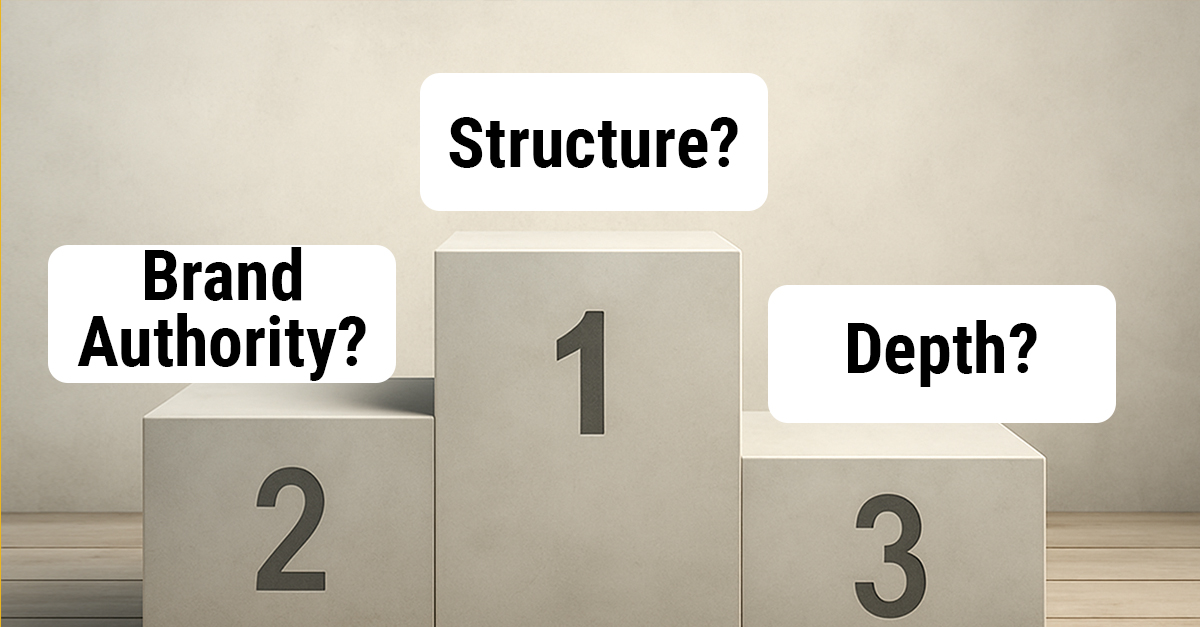
10. How to prioritize if you cannot do everything at once
Resource constraints force sequencing. The most pragmatic order is:
- Structure — align headings, add FAQs, and deploy schema. It is the fastest lift with immediate retrieval impact.
- Depth — expand sections to cover definitions, comparisons, steps, and constraints. Increase semantic density without padding word count.
- Authority — synchronize brand language across your site and external profiles, then pursue corroborating coverage.
Once structure and depth are solid, authority work compounds faster. When AI engines already understand your content, they are more receptive to external signals that say, “This brand is trustworthy.”
11. Rapid-fire FAQs about AI search rewards
- Does AI search still care about backlinks?
- Backlinks matter when they reinforce clarity. AI engines treat them as part of corroboration, not as the primary ranking lever.
- Is long-form content automatically better?
- No. Models reward semantic density, not word count. Concise pages can win if they fully resolve user intent with clear structure.
- Can schema alone fix shallow content?
- Schema improves interpretability, but without depth the model may still skip your page because it lacks contextual coverage.
- How quickly can authority improve?
- Authority rises as soon as your brand language becomes consistent and external references reiterate it. Start by aligning internal copy and schema before pursuing press or directory listings.
- What is the fastest way to see results?
- Audit your top revenue pages with the AI SEO tool, rewrite sections for depth, layer on schema with the schema generator, and verify entity clarity using the AI Visibility Score. Many teams see generative answer inclusion within a few publication cycles.